The Frontier in Automated Intelligence
Click to View the Brochure!
Why the 80/20 Rule Is the Missing Link in AI-Driven Business Transformation
Most organisations are investing in AI. Few are seeing immediate transformational returns. The reason is not technology. It is the process and where to focus.
For more than a century, the Pareto Principle, commonly known as the 80/20 rule, has held true across industries: roughly 80% of outcomes are driven by 20% of activities. In the age of artificial intelligence, this principle is not outdated — it is more relevant than ever, and the golden rule of growth will always be: “It is an 20% effort to keep and maintain a customer, and an 80% effort to gain a new one”
AI does not create value by automating everything. It creates value by amplifying the critical few decisions, actions, and processes that matter most. This insight sits at the heart of how forward‑looking organisations are now approaching AI‑driven business automation.
AI Has a Focus Problem — and the 80/20 Rule Explains Why
Artificial intelligence is no longer a novelty in business. It is also no longer scarce. What is scarce is clarity.
Most organisations today are experimenting with AI across HR, sales, marketing, operations, finance, and innovation — yet many leaders quietly admit that the results feel incremental rather than transformational. The issue is not the capability of AI. The issue is how leaders decide where intelligence should be applied. This is where an old idea becomes newly relevant.
From “AI Everywhere” to “AI Where It Matters”
Many early AI initiatives failed because they focused on breadth instead of leverage:
Automating low‑impact tasks
Deploying tools without strategic alignment
Chasing innovation without measurable business outcomes
The next phase of AI adoption is different. Leading organisations are using AI to identify the vital 20% inside each business function — and then systematically applying intelligence to those areas first.
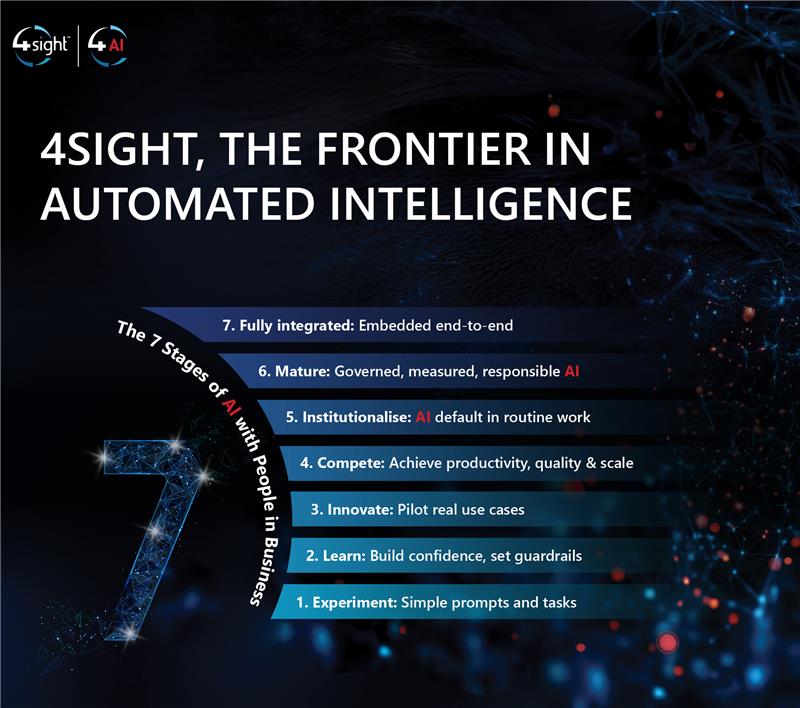
At 4Sight, this approach is structured through the Seven Stages of AI for Business, a maturity model that moves organisations from basic automation to autonomous, self‑reinforcing intelligence.
Applying the 80/20 Principle Across Core Business Functions
Let look at applying the 80/20 principle onto the 5 pillars of business transformation: People, Growth, Operations, Finance and Innovation.
Human Resources: From Administration to Talent Advantage
In People - HR, the highest value is not created by administration. It is created by hiring quality talent, retaining top performers, and developing leadership.
AI enables: Faster, fairer talent screening, predictive insights into attrition risk and data‑driven workforce planning. The result is an HR function that moves beyond process management to measurable talent return on investment.
4Sight Stage | HR Focus (20%) | Automation / Intelligence Impact |
1–2 | Payroll, leave, compliance | Removes low-value admin work |
3 | Talent screening, CV matching | Improves recruiter throughput |
4 | Performance insights | Better promotion & reward decisions |
5 | Attrition prediction | Retains top 20% performers |
6 | Autonomous workforce planning | Dynamic role & skills allocation |
7 | Org design innovation | Continuous talent model evolution |
Outcome: HR shifts from cost centre → talent ROI engine
GROWTH: Sales: Focusing on the Revenue That Actually Matters
In most organisations, a small portion of customers generate most of the revenue and a minority of opportunities deliver the majority of margin. AI allows sales teams to prioritise high‑probability opportunities, predict churn before it happens and guide sales actions in real time. This shifts sales from activity volume to revenue precision.
4Sight 7 Stages | Sales Focus (20%) | Automation / Intelligence Impact |
1–2 | CRM updates, reporting | Frees selling time |
3 | Lead scoring | Focus on high-conversion prospects |
4 | Next-best-action guidance | Improves win rates |
5 | Deal & churn prediction | Protects revenue concentration |
6 | Autonomous pipeline management | Self-optimising sales execution |
7 | New revenue model creation | AI-enabled offerings & pricing |
Outcome: Sales effort concentrates where best margin exists
Marketing: Precision Over Spend
Marketing has long been governed by the 80/20 rule: Only a few channels drive most conversions, and a small number of messages create real engagement. With AI, organisations can identify which audiences convert before campaigns launch, allocate spend dynamically to high‑performing channels and continuously optimise content and messaging. The outcome is higher impact with lower waste.
4Sight Stage | Marketing Focus (20%) | Automation / Intelligence Impact |
1–2 | Campaign execution | Faster, cheaper delivery |
3 | Content optimisation | Higher engagement rates |
4 | Attribution intelligence | Budget shifts to winning channels |
5 | Predictive segmentation | Anticipates demand |
6 | Autonomous spend allocation | Continuous ROI optimisation |
7 | Market creation | AI-generated products & narratives |
Outcome: Less spend, higher conversion density
Operations: Eliminating Bottlenecks, Not Just Costs
Operational inefficiency rarely comes from everywhere. It comes from a small number of bottlenecks, exceptions, and failure points. AI makes it possible to predict disruptions before they occur, automatically rebalance workloads and create self‑healing operational processes. Operations evolve from cost efficiency to resilience and scalability.
4Sight Stage | Operations Focus (20%) | Automation / Intelligence Impact |
1–2 | RPA for repetitive steps | Cost and error reduction |
3 | Process visibility | Root-cause clarity |
4 | Decision support | Faster throughput |
5 | Failure prediction | Prevents disruption |
6 | Autonomous orchestration | Self-healing operations |
7 | Operational innovation | New operating models |
Outcome: Operations move from efficiency → resilience and scale
Finance: From Retrospective Control to Predictive Insight – Hindsight to 4Sight:
Traditional finance looks backwards. High‑performing finance functions look forward.
AI enables predictive cash‑flow forecasting, early detection of financial risk and scenario‑based decision modelling. Finance becomes a strategic partner to the business, not just a reporting function.
4Sight Stage | Finance Focus (20%) | Automation / Intelligence Impact |
1–2 | Transaction processing | Faster close cycles |
3 | Variance analysis | Early anomaly detection |
4 | Scenario modelling | Better executive decisions |
5 | Forecasting & risk prediction | Capital protection |
6 | Autonomous controls | Continuous compliance |
7 | Strategic finance innovation | AI-driven business models |
Outcome: Finance becomes predictive and strategic, not retrospective
Innovation: Making Breakthrough Repeatable
Innovation is often treated as accidental. In reality, most future value comes from a small number of insights and experiments. AI helps organisations to detect emerging patterns and trends, prioritise the right ideas early and scale successful innovation faster. This turns innovation from chance into a system.
4Sight Stage | Innovation Focus (20%) | Automation / Intelligence Impact |
1–2 | Idea intake automation | Faster experimentation |
3 | Pattern detection | Better idea quality |
4 | Portfolio decisioning | Smarter bets |
5 | Trend prediction | Early-mover advantage |
6 | Autonomous experimentation | Rapid scaling |
7 | Continuous reinvention | Innovation as a system |
The 4Sight Seven Stages of AI: A Practical Maturity Path
The real power of AI is unlocked progressively:
Task Automation – Removing manual effort
Process Automation – Streamlining workflows
Assisted Intelligence – Supporting human decisions
Augmented Decision‑Making – Improving judgement quality
Predictive Intelligence – Anticipating outcomes
Autonomous Intelligence – Self‑managing systems
Innovative Intelligence – Continuous reinvention
Each stage builds on the previous one — and each stage increases the organisation’s ability to apply AI to the 20% that drives 80% of results.
A New Leadership Imperative
AI is no longer an IT conversation; it is a leadership discipline. The organisations that will outperform in the next decade are not those with the most AI tools, but those with the clearest focus:
Where value is truly created
Which decisions matter most
How intelligence should be applied responsibly and strategically
The future of business automation is not about replacing people.
It is about amplifying human impact where it counts.
About 4Sight and 4AI – 4Sight Intelligent Automation:
4Sight enables organisations to design, deploy, and scale AI‑driven business automation through structured maturity models, data intelligence, and responsible AI adoption, that why we were the 2025 finalist worldwide for Microsoft Automated Intelligence partner of 2025.