Channel Partner Blog
6 August 2026
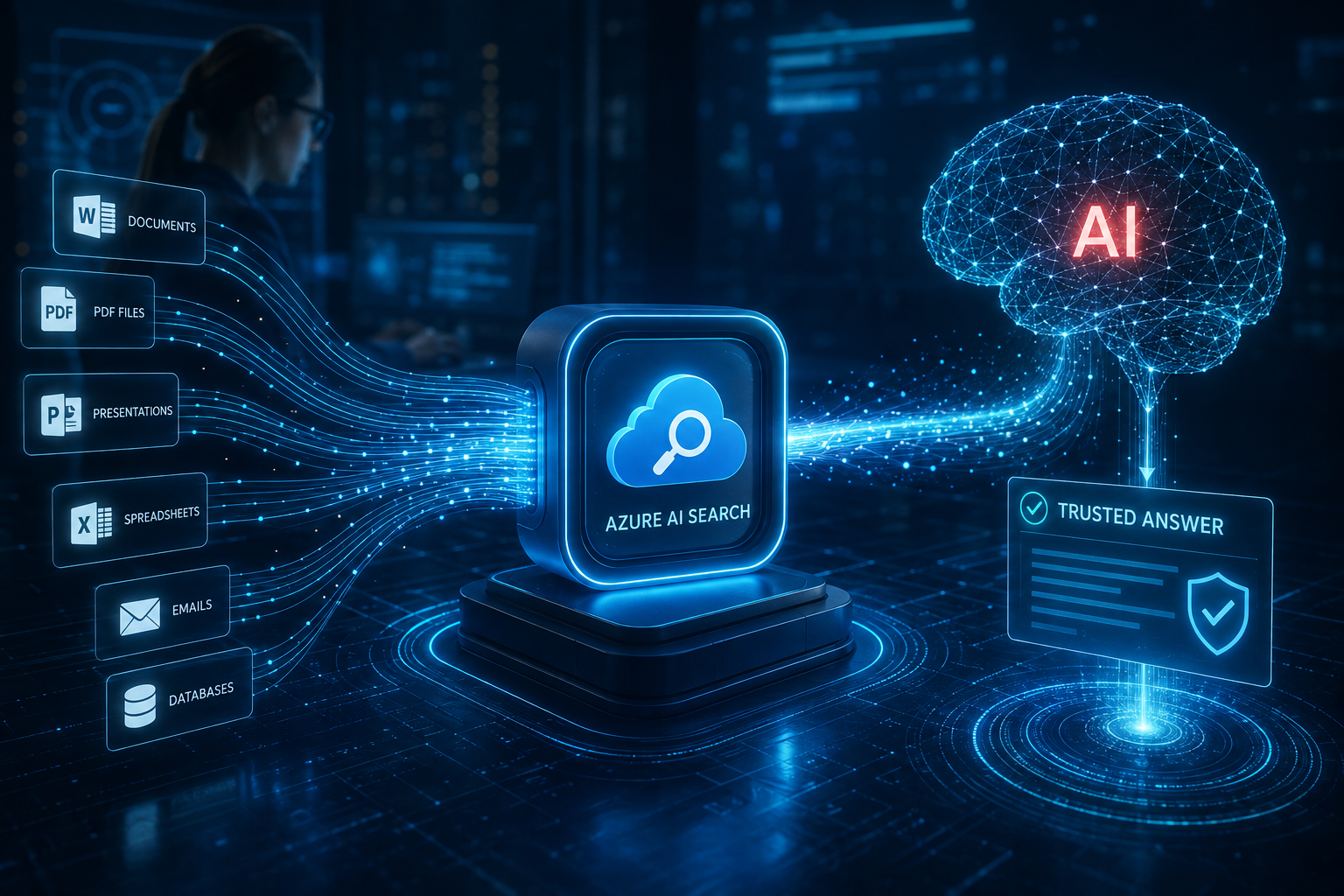
Artificial Intelligence (AI) is rapidly transforming the way organizations operate across Africa. From automating routine tasks and improving customer experiences to enhancing decision-making and unlocking new business opportunities, AI is becoming a critical component of digital transformation strategies.
The Confident Chatbot That Makes Things Up
Plenty of customers have now built a chatbot. They are proud of it, until it confidently invents a refund policy that does not exist, or cannot find a document that is plainly sitting in SharePoint. The model is clever; it simply has no reliable way to look things up in the customer's own content.
That gap, between a fluent answer and a correct one, is where most AI projects quietly stall. An assistant that cannot ground its answers in real, current company data is a liability, not an asset. Azure AI Search is the retrieval engine that closes the gap, and it is fast becoming the unglamorous part of AI that decides whether a project ships or stalls.
Why This Matters Now
The first wave of AI enthusiasm proved that customers want assistants over their own knowledge. The second wave is teaching them a harder lesson: a large language model on its own does not know your prices, your policies or your product catalogue, and it will happily guess. Retrieval-augmented generation, or RAG, is the pattern that fixes this by feeding the model relevant, trusted snippets at answer time.
For African businesses, this matters in a very practical way. The opportunity is not to train a model from scratch, which is costly and out of reach for most, but to ground a capable existing model in their own documents. That is achievable, affordable and genuinely transformative for support desks, internal knowledge and customer self-service.
For partners, AI Search is where the real, repeatable AI services revenue sits. Everyone can demo a chatbot. Far fewer can make it accurate, secure and production-ready over a messy pile of enterprise content, and that difficult middle is exactly where your expertise becomes valuable and defensible.
The timing is helpful as well. Customers who experimented last year and got burned by a hallucinating prototype are now ready to do it properly, with grounding, citations and access control built in from the start. That shift from novelty to seriousness is precisely the moment a trusted partner should be in the room, steering them towards an architecture that will survive contact with real users.
THE 4SIGHT ANGLE The model gets the applause, but retrieval does the work. Partners who master AI Search own the part of every AI project that is hardest to copy and easiest to bill for. |
What Azure AI Search Actually Does
Azure AI Search is a fully managed, cloud-hosted service that connects your data to AI, unifying access to enterprise and web content so agents and models can produce grounded, reliable answers. Think of it as the librarian that finds the right passages, so the model can read from facts rather than from memory.
It starts with indexing. Indexers crawl supported sources, Azure Blob Storage, Cosmos DB, SQL Database, OneLake, SharePoint and more, and an AI enrichment pipeline can chunk documents, generate vector embeddings, run OCR over images and otherwise make raw content searchable. At query time you are not limited to keyword matching: AI Search supports full-text, vector, hybrid and multimodal queries, with semantic ranking to re-score results by meaning rather than literal words.
The service now offers two engines. Classic search is an index-first model for fast, predictable queries, and is the proven, generally available path for RAG using hybrid search and semantic ranking. Agentic retrieval, currently in preview, adds an LLM-assisted layer that plans a complex question into parallel subqueries across one or more knowledge sources, then returns a structured response with citations and a query plan.
Crucially for enterprise work, it brings Microsoft Entra security, role-based and document-level access control and Private Link, so an assistant only ever retrieves content a given user is allowed to see.
The Partner Opportunity
AI Search underpins a productisable offer: a grounded knowledge assistant built on a customer's own content. The discovery question is easy, where does your team waste time hunting for information, and the answer points straight at a fundable project.
The services to wrap are substantial and genuinely skilled. Data preparation and chunking strategy, designing the index and embeddings, choosing classic hybrid search versus agentic retrieval, tuning relevance, and wiring access control so the assistant respects existing permissions. This is consulting work that resists commoditisation precisely because every customer's content is different.
It bundles naturally with the wider Azure AI stack, connecting to Azure OpenAI and Microsoft Foundry, and with the data-platform work many partners already do. Because the dedicated pricing model bills on provisioned capacity while a serverless option is emerging in preview, you can also advise on cost design, an advisory role customers value.
Then comes the annuity: keeping content fresh with scheduled indexing, monitoring relevance, and expanding the assistant to new sources over time. We see partners land a single departmental use case, prove the accuracy, and grow it across the organisation, one knowledge source at a time.
It is worth being honest with customers that relevance is a craft, not a switch. The first index rarely answers everything perfectly, and the tuning that follows, adjusting chunking, weighting hybrid results, refining what gets retrieved, is ongoing, billable work that genuinely improves the product. Framing that as continuous improvement rather than a defect sets healthy expectations and keeps you engaged well beyond go-live.
What the Customer Gets Out of It
For the customer, the difference is an AI assistant they can actually trust. Answers are grounded in their real, current documents, and because agentic retrieval and the classic pattern both surface citations, staff can see where an answer came from instead of taking it on faith.
That trust unlocks the use cases that were too risky before. Support agents get instant, sourced answers from policy and product documentation. Employees find buried knowledge in seconds rather than emailing three colleagues. Customers self-serve accurately, easing the load on the help desk.
And it all happens within the customer's security boundary. Because retrieval honours role-based and document-level permissions, a junior employee's assistant cannot surface a document meant for the executive team. The outcome is faster, more accurate service without trading away governance, which is exactly the combination cautious organisations have been waiting for before they commit to AI.
There is a knowledge-retention benefit that is easy to overlook. When experienced staff leave, their hard-won understanding often walks out with them. An assistant grounded in the organisation's documents turns that scattered institutional memory into something searchable and durable, so a new joiner can find the right answer in seconds rather than waiting weeks to absorb it the hard way.
Getting Started
You can stand up a credible proof of concept on a contained dataset this week, and a focused win on real content will teach you more than any amount of theorising. A sensible path:
● Pick one high-value, well-bounded content set, a support knowledge base or an HR policy library, rather than boiling the ocean.
● Read the AI Search overview and the RAG guide to decide between the generally available classic hybrid pattern and preview agentic retrieval.
● Create a search service, point an indexer at the source, and switch on chunking and vectorisation to build a hybrid index.
● Test relevance with real user questions and turn on semantic ranking; sort out access control before anything goes near production.
● Bring our Surestep Ambassador team in to help with index design, cost modelling and connecting the assistant to Azure OpenAI or Microsoft Foundry.
Microsoft Learn Resources
📖 Learn more: What is Azure AI Search? · Introduction to the service, its two engines and dedicated versus serverless pricing.
📖 Learn more: Retrieval-augmented generation (RAG) in Azure AI Search · How agentic retrieval and classic RAG solve real grounding challenges.
📖 Learn more: Features of Azure AI Search · The full capability list, from knowledge sources and query planning to AI enrichment.
📖 Learn more: Indexers in Azure AI Search · How the pull model crawls supported data sources and drives enrichment.
Build AI That Knows What It Is Talking About
At 4Sight we help partners turn AI ambition into accurate, production-ready solutions. Visit https://4sight.cloud to see how we support your AI practice, and contact our Surestep Ambassador team at channel@4sight.cloud to scope your first grounded assistant. Let's give those chatbots something true to say.
The opportunities are significant, and adoption is accelerating.
However, as organizations rush to embrace AI, a critical question is emerging:
Can your organization trust the information it provides to Artificial Intelligence?
While much of the conversation around AI focuses on algorithms, models, and capabilities, the true foundation of successful AI lies elsewhere. AI systems are only as effective as the data they are given. Without trusted, secure, and well-governed information, even the most sophisticated AI solution can produce inaccurate, misleading, or potentially harmful outcomes.
As AI becomes more deeply integrated into business operations, organizations must recognize that responsible AI begins long before data reaches an AI platform.
It begins with trusted data.
Artificial Intelligence Is Only as Good as Its Data
AI systems generate insights, predictions, recommendations, and decisions by analyzing information. The quality of those outputs is directly linked to the quality of the data being used.
When data is incomplete, inaccurate, outdated, duplicated, or poorly governed, the resulting AI outputs become unreliable. In some cases, organizations may make critical business decisions based on flawed information without realizing the underlying data was compromised.
This challenge is not unique to Africa, but it is becoming increasingly relevant as organizations across the continent accelerate digital transformation initiatives.
Many organizations are investing heavily in AI technologies without first ensuring that their data foundations are secure and properly governed. While AI may be capable of processing vast amounts of information, it cannot automatically determine whether that information is trustworthy.
Poor-quality data can lead to:
Inaccurate business insights
Biased or misleading recommendations
Increased operational risk
Reduced customer trust
Regulatory and compliance challenges
Poor return on AI investments
The success of any AI initiative ultimately depends on the integrity, availability, and governance of the information that feeds it.
Before organizations ask what AI can do, they should first ask whether their data can be trusted.
The Growing Risk of Uncontrolled Data Exposure
As generative AI platforms become more accessible, employees are increasingly using AI tools to improve productivity, accelerate research, create content, analyze data, and automate routine activities.
While these tools offer significant benefits, they also introduce new risks.
In many cases, employees may unknowingly upload sensitive information into external AI platforms without understanding how that information is stored, processed, or retained.
Confidential business information, customer records, intellectual property, financial data, contracts, strategic plans, and operational documentation may all become exposed if appropriate controls are not in place.
For organizations operating in highly regulated industries such as financial services, healthcare, government, manufacturing, and professional services, the consequences can be significant.
The challenge is no longer simply enabling AI.
The challenge is governing AI.
Organizations need confidence that sensitive information remains protected while still enabling innovation and productivity.
Secure Before You Share
Many organizations focus on controlling AI after information has already been uploaded or accessed.
However, a far more effective approach is to secure and govern enterprise data before AI systems can interact with it.
This shift in thinking changes the conversation from reactive control to proactive governance.
When organizations secure their information first, they gain greater visibility and control over how AI technologies access and use data.
A governance-first approach enables organizations to determine which information AI platforms may access, who can authorize access, when information becomes available, and how every interaction is monitored and recorded.
Rather than restricting innovation, this approach creates a secure framework that allows organizations to explore AI opportunities with greater confidence.
The objective is not to prevent AI adoption.
The objective is to ensure that AI operates within clearly defined governance boundaries that protect sensitive information and align with organizational policies.
Data Governance Is Becoming AI Governance
As AI adoption increases, the line between data governance and AI governance is becoming increasingly blurred.
Organizations cannot effectively govern AI if they do not first govern their data.
Questions surrounding AI ethics, transparency, accountability, and compliance ultimately depend on understanding where information originates, how it is managed, who has access to it, and how it is protected.
Without strong data governance, organizations may struggle to answer critical questions such as:
Where did this AI-generated recommendation come from?
What data was used to create it?
Was sensitive information involved?
Was access properly authorized?
Can the decision-making process be audited?
These questions are becoming increasingly important as regulators, customers, investors, and boards demand greater accountability around AI usage.
The organizations that establish strong governance foundations today will be better prepared to manage the opportunities and risks associated with AI tomorrow.
The Rise of Responsible AI in Africa
Across Africa, governments and regulatory bodies are actively exploring frameworks to support responsible AI adoption.
At the same time, existing privacy and cybersecurity regulations continue to evolve, placing greater emphasis on accountability, transparency, and information governance.
Customers are becoming more aware of how their information is used.
Investors are evaluating governance practices more closely.
Boards increasingly recognize AI as both a strategic opportunity and a potential risk.
As a result, organizations are under growing pressure to demonstrate that AI initiatives are being implemented responsibly.
Responsible AI extends beyond technical performance.
It requires organizations to establish governance structures that ensure information is secure, authorized, and appropriately managed throughout its lifecycle.
In many ways, responsible AI is simply the next evolution of responsible data management.
Building Trust Through Transparency
Trust remains one of the most valuable assets in the digital economy.
Customers trust organizations with their personal information.
Employees trust systems to support their work.
Partners trust shared information to remain secure.
Regulators trust organizations to operate responsibly.
AI can strengthen these relationships, but only when it operates within a framework of transparency and accountability.
Organizations that can demonstrate how information is protected, governed, and used within AI systems are more likely to earn and maintain stakeholder trust.
This includes maintaining clear audit trails, implementing appropriate access controls, and ensuring that sensitive information remains protected throughout AI workflows.
Transparency is not simply a compliance requirement.
It is a business advantage.
The organizations that build trust today will be better positioned to unlock the long-term value of AI tomorrow.
Trusted Data Creates Trusted Outcomes
AI is often viewed as a technology initiative.
In reality, successful AI adoption is a data initiative.
The organizations that derive the greatest value from AI will not necessarily be those with the most advanced algorithms. They will be the organizations that have established strong foundations of data quality, governance, security, and resilience.
Trusted data enables trusted insights.
Trusted insights enable better decisions.
Better decisions drive stronger business outcomes.
This is why organizations must prioritize protecting, governing, and controlling their information before expanding AI adoption.
Without trusted data, AI introduces uncertainty.
With trusted data, AI becomes a powerful driver of innovation, efficiency, and growth.
The Future Belongs to Responsible AI Leaders
AI will undoubtedly play a transformative role in Africa's digital future.
Organizations across every sector will continue exploring new ways to improve services, enhance productivity, and create value through intelligent technologies.
However, long-term success will depend on more than simply adopting AI.
It will depend on adopting AI responsibly.
The organizations that lead in the coming years will be those that establish strong governance frameworks, protect sensitive information, maintain visibility over data usage, and ensure that AI operates using authorized and trusted enterprise information.
Trusted Artificial Intelligence begins with trusted data.
And trusted data begins with protecting the data itself.
Building a Foundation for Trusted AI with Binarii Labs
Binarii Labs helps organizations strengthen the security, governance, and resilience of their most valuable asset: their data. Through sovereign-first data protection, advanced encryption, distributed storage architectures, and enhanced governance capabilities, organizations can maintain greater control over how information is protected and accessed.
By securing data before it is consumed by AI systems, organizations can build a stronger foundation for responsible innovation while reducing risk and maintaining trust.
As AI adoption accelerates across Africa, organizations need solutions that enable both innovation and governance. Trusted AI requires trusted data, and trusted data requires protection by design.
Ready to strengthen the foundation for responsible AI?
Discover how Binarii Labs can help your organization protect critical information, improve governance, and support trusted innovation in the age of Artificial Intelligence.
Contact our team: channel@4sight.cloud
