Channel Partner Blog
Co-Selling With Microsoft: The Skill Most Resellers Never Learn
2 September 2026
Ask a room of Microsoft partners how they plan to grow next year and you'll get a familiar list. Hire another seller. Add a new product line. Push harder on renewals. All valid. All slow, expensive, and entirely dependent on your own capacity.
Now ask that same room how many have ever run a deal with Microsoft rather than merely through Microsoft — jointly, with a Microsoft seller in the conversation, working the same opportunity toward the same close. The hands go down fast.
That gap is the most expensive blind spot in the African channel. Because co-selling is the one growth lever that doesn't require you to add headcount, cut margin, or buy leads. It requires you to learn a motion — and most partners have simply never been taught it.
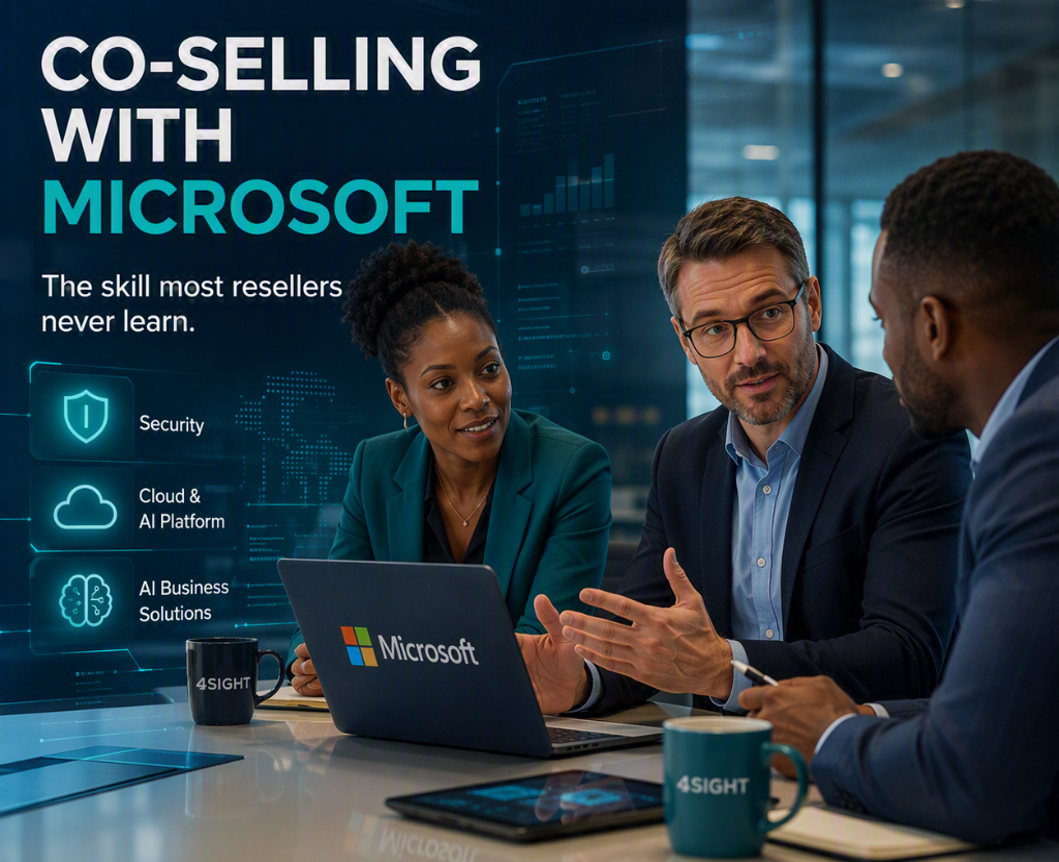
It's telling that when Microsoft built its EMEA Partner Sales Training Series, it didn't organise the curriculum around products. It organised it around three solution areas — Security, Cloud and AI Platform, and AI Business Solutions — and gave all three the same stated purpose: to empower Microsoft partners with the skills, tools, and clarity to co-sell effectively and pitch with impact.
Skills. Tools. Clarity. That phrasing is deliberate, and each word maps to a reason partners fail at co-sell.
Why partners don't co-sell (it isn't laziness)
The usual explanation is that partners are too busy. That's rarely the real reason.
The real reason is that co-selling looks like a relationship problem, so partners treat it like one. They assume the route in is knowing the right person at Microsoft — a friendly account executive, an introduction at a partner event, a lucky break. So they network, wait, and nothing happens.
Co-selling isn't a relationship problem. It's a process problem wearing a relationship costume.
A Microsoft seller has a territory, a quota, a set of priorities handed down from above, and a limited number of hours. They will happily bring a partner into an account — but only when that partner makes their life easier and their number more likely. Everything about successful co-sell flows from that one sentence.
Partners who never learn the motion show up asking, in effect, "do you have any leads for me?" Partners who have learned it show up saying, "I've got a customer with this problem, here's the solution area it lands in, here's what I can deliver, and here's where I need you." One of those is a request. The other is a contribution. Only one gets a reply.
Skills: speaking Microsoft's language, not your own
Here's an uncomfortable truth for a lot of experienced resellers — your product knowledge may be working against you.
Microsoft has reorganised how it talks about its own business, into solution areas like AI Business Process, AI Workforce, Cloud & AI Platform and Security. That's not marketing decoration. That taxonomy is how territories are structured, how sellers are measured, and how opportunities get routed internally.
If you walk into a co-sell conversation describing your deal in legacy SKUs and old category names, you're asking a Microsoft seller to do the translation work for you — to figure out which of their priorities your opportunity serves. Most won't bother. Not out of unhelpfulness, but because three other partners have already framed theirs correctly.
This is the "skills" part, and it's learnable in an afternoon. It isn't about knowing more technology. It's about placing your opportunity inside Microsoft's map so precisely that the seller instantly sees where it fits their year. That's exactly what the Selling with Microsoft learning paths are built to teach — and they're free the moment you register on Cloud Champion.
Tools: the assets you're entitled to and aren't using
The second failure point is that partners try to co-sell with materials they built themselves.
There's an entire layer of go-to-market machinery sitting unused: pitch structures, playbooks, GTM guidance, and the investment and incentive programmes behind each solution area. Cloud Champion runs dedicated learning paths on precisely this for the SMB segment — covering Security, AI Business Process, AI Workforce, data platform with Microsoft Fabric, and estate migration and modernisation — all built to explain the investments and incentives available to partners building differentiated practices.
Read that again, because it's the part partners skim. These aren't courses about products. They're courses about money and motion — what Microsoft will fund, support and prioritise, and how a partner plugs into it.
A partner who knows which incentives apply to a deal walks into a co-sell conversation with something genuinely valuable: a proposal that's already commercially viable for both sides. A partner who doesn't know is negotiating blind, usually against their own margin.
Clarity: knowing which deals are actually co-sell deals
The third skill is the most underrated — and it's mostly about saying no.
Not every opportunity should be co-sold. A straightforward licence renewal doesn't need a Microsoft seller in the room, and dragging one in burns credibility you'll want later. Co-sell earns its keep on the deals that are genuinely bigger than you: complex migrations, security transformations, AI workloads where the customer is nervous and the risk is real.
Clarity means being able to look at your pipeline on a Monday morning and sort it — this one I run alone, this one I need backup on, this one I shouldn't touch without help. Partners who develop that instinct stop wasting goodwill and start building a reputation as someone worth working with. And reputation, in the co-sell world, compounds. The partner who brought a clean, well-qualified deal last quarter is the partner who gets the call this quarter.
The bit nobody tells you: you don't start alone
Most articles about co-selling end here, leaving you motivated and stuck. So let's be practical about the first step.
You don't begin by cold-calling Microsoft. You begin with the distributor relationship you already have. Cloud Champion isn't a standalone video library — it sits on top of 4Sight's ecosystem as a Microsoft Cloud Solution Provider (CSP) Indirect Provider, which means partners get onboarding, presales help, and escalation paths across Azure, Microsoft 365, and Dynamics 365, plus a route into regional programmes, pricing guidance and incentives support.
That's your practical on-ramp. Presales support means you can credibly commit to a deal that's technically beyond your current bench. Incentives guidance means you can price it properly. Regional programme access means you're aligned to what Microsoft is actually funding this year rather than guessing.
Small partners routinely assume co-sell is for the big players. It's precisely the opposite. Co-sell is how a small partner takes on a deal that should have been out of reach — because the expertise, the backup and the commercial support are borrowed rather than owned. Registration takes about a minute: name, company, country and your role, and you're in.
Ready to learn the motion? 👉 Register free at Cloud Champion and start with the Selling with Microsoft learning path for your solution area — Security, Cloud and AI Platform, or AI Business Solutions.
