From MPC to AI-Driven Autonomy
The Next Frontier for Oil & Gas Process Control

For decades, Model Predictive Control (MPC) has been the gold standard
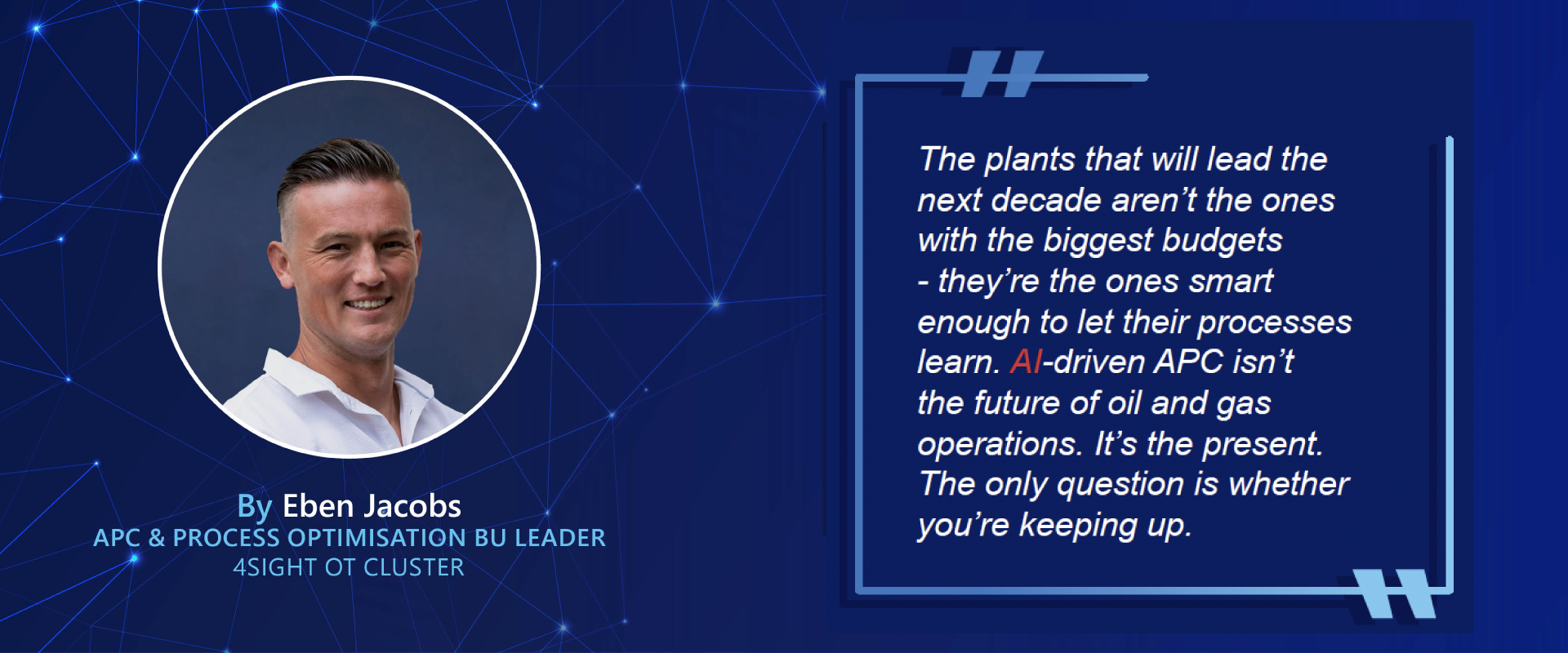
For decades, Model Predictive Control (MPC) has been the golden standard of Advanced Process Control (APC) in oil and gas. It transformed refining and upstream operations, enabling engineers to manage complex, multivariable processes with remarkable precision. But here’s the uncomfortable truth: most plants are still leaving significant efficiency on the table - and the industry’s next evolution is already underway. The convergence of artificial intelligence, machine learning, and APC is not a future possibility. It is happening now, at scale, and the operators who understand this shift will define the next decade of operational performance.
The limits of traditional MPC
MPC works by building a mathematical model of a process and using it to predict future behaviour, adjusting control outputs in real time. It was - and remains - a powerful tool. But it has inherent limitations.
Classical MPC relies on linear models that are built once, validated, and then maintained manually. As plant conditions drift - feedstock changes, equipment ages, seasonal variations kick in - those models degrade. Engineers spend enormous effort keeping controllers relevant. And when processes become highly nonlinear or deeply interconnected across units, conventional MPC begins to struggle.
The result: controllers that are technically running, but not performing at their potential.
Enter AI-driven APC
This is where simulation changes the game.
AI and machine learning change the fundamental nature of process control. Instead of a static model built by engineers, AI-driven APC uses data-driven models that learn continuously from live plant data. They adapt. They self-correct. They identify patterns that no human - and no linear model - could detect.
The results are striking. At ADIPEC in November 2025, a landmark paper demonstrated the deployment of AI-enabled APC in Gas Oil Separation Plants (GOSPs), using machine learning models to simultaneously maximise oil production, maintain crude specifications, optimise energy and wash water consumption, and detect slug disturbances in real time. This is not incremental improvement - it is a fundamentally different way of operating.
Industry data backs this up. Today, 28% of APC upgrades globally incorporate AI-driven predictive analytics, and the market is growing at over 10% per year as operators recognise the returns.
Digital twins: the new control room backbone
AI-driven APC does not work in isolation. It is most powerful when integrated with digital twin technology - virtual replicas of physical assets that are updated continuously with live sensor data. Together, they create what is rapidly becoming the new architecture of intelligent process plants.
The operating loop looks like this: the digital twin simulates current and future plant states, the AI control layer identifies the optimal operating point, actions are implemented autonomously, and outcomes feed back into the model to improve it further. Early adopters of this approach are already seeing 15–20% reductions in unplanned downtime, alongside measurable gains in throughput and energy efficiency.
Honeywell’s 2025 launch of its Plant-Wide Optimizer module for Forge APC signals where the industry is heading: away from unit-level control towards facility-wide, integrated optimisation driven by real-time analytics.
What this means for African operators
One of the most significant shifts accompanying the AI-APC revolution is the move to cloud and SaaS-based deployment. Over 70% of new APC installations are expected to be SaaS-based by 2026. This dramatically lowers the barrier to entry - making sophisticated process control accessible not just to supermajors, but to mid-tier and emerging-market operators across Sub-Saharan Africa.
The technology gap that once separated a world-class refinery in Houston from an operation in Johannesburg or Lagos is narrowing fast. The question is whether African operators will seize this window.
The 4Sight perspective
At 4Sight Operational Technologies, we work at the intersection of global APC innovation and local implementation reality. Deploying AI-driven process control is not simply a technology decision - it requires deep understanding of your specific process conditions, your data infrastructure, your workforce capabilities, and your operational goals.
The opportunity is real. The technology is ready. The question every process plant leader needs to ask is not whether to make this shift - but how quickly they can afford not to.
From Questions to Confidence
At 4Sight Operational Technologies, we see simulation as a critical enabler in bridging the gap between data and decision-making.
It empowers organisations to move beyond uncertainty and into a space where decisions are tested, validated, and optimised before they are executed. Because ultimately, the goal is not just to ask better questions.
It is to make better decisions.