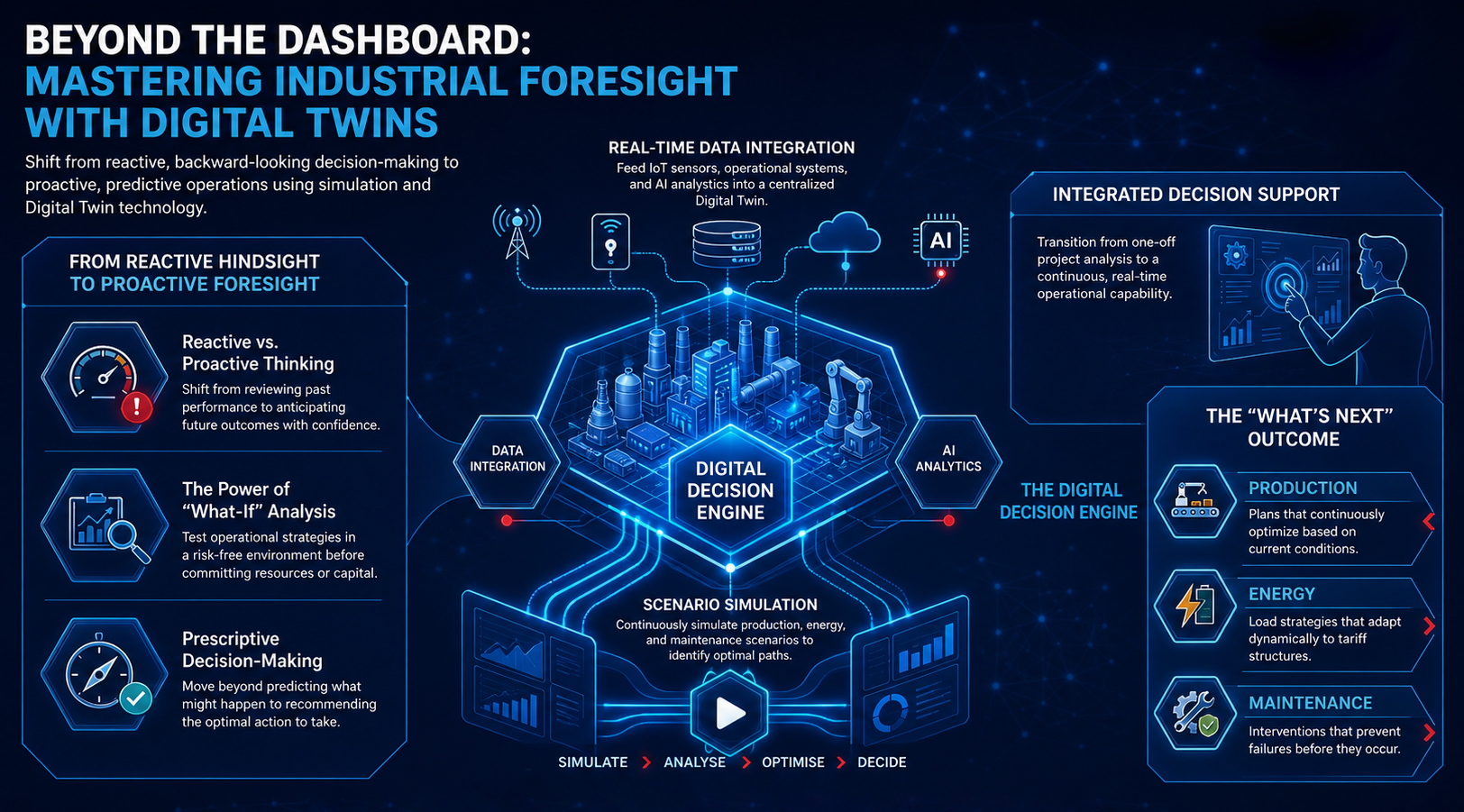
From 'What If' to What's Next
How Simulation is Redefining Decision-Making in Industry
The best decisions aren’t made in the moment—they’re tested long before they happen.
In today’s industrial landscape, the margin for error is shrinking. Rising energy costs, operational complexity, and increasing pressure to improve efficiency mean that decisions can no longer rely solely on experience, instinct, or historical reporting.
Yet, many organisations still operate this way—reviewing dashboards, analysing past performance, and making forward-looking decisions based on incomplete visibility.Yet, many organisations still operate this way—reviewing dashboards, analysing past performance, and making forward-looking decisions based on incomplete visibility.
The question is no longer “Do we have fragmented data and visibility?”
The real question is: “Are we using it to understand what to do next?”
The Problem with Traditional Decision-Making
For decades, industrial decision-making has been largely reactive. Reports tell us what has happened. Dashboards highlight where performance has deviated. Experts interpret the data and make informed decisions.
While this approach has served its us well, it comes with inherent limitations:
• It is backward-looking, not forward-thinking
• It relies heavily on human interpretation, assumptions and domain specific expertise
• It struggles to account for complex, interconnected variables
• It leaves organisations exposed to unforeseen risks and inefficiencies
In an environment where a single decision can impact production, cost, safety, and sustainability, this approach is no longer sufficient.
The Rise of “What-If” Thinking
This is where simulation changes the game.
Simulation introduces the ability to ask a fundamentally different question: “What happens if we do that?”
Instead of committing to a decision and managing the consequences, organisations can now test scenarios in a controlled, risk-free environment before taking action.
This “what-if” approach allows teams to:
• Evaluate multiple operational strategies
• Understand the impact of variability and changes (energy, throughput, resources)
• Identify optimal outcomes before implementation
• Reduce uncertainty and risk
For example, a mining operation can simulate how changes in processing rates affect energy consumption and recovery. An energy-intensive plant can model tariff impacts before adjusting load strategies. Maintenance teams can explore the consequences of delayed interventions versus proactive scheduling. A supply chain operation can model the ripple effects of supplier delays, inventory fluctuations, or demand spikes - optimising sourcing and logistics decisions before disruptions impact production.
The result? Decisions grounded in foresight, not assumption.
From Insight to Action
However, simulation is no longer just about running isolated models.
The real shift we are seeing across industry is the move from once-off analysis to integrated, continuous decision support.
By connecting simulation models to real operational data, organisations can create dynamic environments where scenarios are constantly updated and refined. This is where simulation begins to evolve into something far more powerful—an operational capability rather than a project-based tool.
Combined with advancements in data platforms and artificial intelligence, simulation becomes:
• Faster, enabling near real-time scenario evaluation
• Smarter, incorporating patterns and predictive insights
• More accessible, supporting both engineers and decision-makers
This convergence is laying the foundation for digital twins and AI-enabled operations—where businesses are no longer reacting to change, but actively anticipating it.
Defining “What’s Next”
The natural progression of “what-if” thinking is moving toward “what’s next.”
This is where leading organisations are setting themselves apart.
Instead of asking:
• What might happen?
• They are asking:
• What should we do next, based on all possible outcomes?
This shift introduces predictive and prescriptive decision-making, where simulation not only evaluates scenarios but also recommends optimal actions.
In practical terms, this means:
• Production plans that continuously optimise based on current conditions
• Energy strategies that adapt dynamically to tariff structures
• Maintenance decisions that prevent failures before they occur
• Operations that balance efficiency, cost, and sustainability in real time
• Make value and outcome based decision
Simulation, in this context, becomes embedded into daily workflows—supporting decisions at every level of the organisation.
A New Competitive Advantage
What we are witnessing is more than a technological evolution. It is a shift in how organisations operate and compete.
The advantage is no longer held by those who can react the fastest.
It belongs to those who can anticipate the future with confidence. Organisations that embrace simulation and “what-if” thinking are able to:
• Reduce operational risk
• Improve efficiency and cost control
• Accelerate decision-making
• Unlock new levels of performance
Those that don’t risk falling behind—continuing to make critical decisions without fully understanding their consequence.
From Questions to Confidence
At 4Sight Operational Technologies, we see simulation as a critical enabler in bridging the gap between data and decision-making.
It empowers organisations to move beyond uncertainty and into a space where decisions are tested, validated, and optimised before they are executed. Because ultimately, the goal is not just to ask better questions.
It is to make better decisions.
Final Thought
The future of industry will not be built on guesswork.
It will be built on organisations that simulate, test, and refine their strategies before acting and doing it rapidly. The most successful businesses won’t just ask “what if?”—they will define what’s next.