The 7 Stages of aI for Engineers in Industry
Not Just an AI Tool
Artificial Intelligence is no longer a future concept for industry—it is already embedded in how engineers analyse data, understand operations, and make decisions. Yet many industrial organisations struggle with the same question: Where do we realistically start with AI, and how far should we go?
At 4Sight Operational Technologies, we see successful AI adoption not as a single transformation project, but as a progressive journey. One that moves deliberately from human-led decision making to assisted intelligence, and eventually toward autonomous, optimised operations.
This journey can be clearly described through seven distinct stages of AI maturity for engineers in industry.
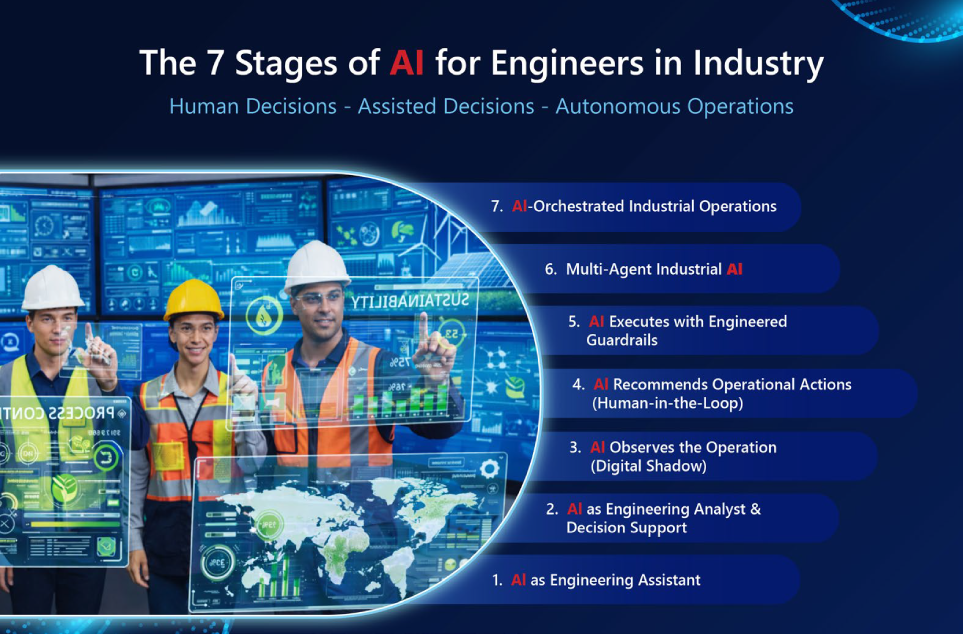
Stage 1: AI as an Engineering Assistant
The first stage introduces AI as a non-operational assistant. At this level, AI helps engineers interpret information, summarise documentation, and access institutional knowledge faster—but it has no authority over the process.
Typical use cases include summarising operating procedures, explaining control logic, interpreting alarms and event logs, and generating shift handover notes. The value here is speed and clarity, not control. Importantly, this stage builds AI literacy while enforcing strict guardrails around safety and operational risk.
Stage 2: AI as an Engineering Analyst and Decision Support
In Stage 2, AI begins analysing operational technology (OT) data to explain why systems behave the way they do. Engineers remain fully in control, but decisions are now supported by deeper, faster insights.
Here we see historian-based root cause analysis, production constraint identification, energy benchmarking, and quality deviation investigation. This is often the highest-value entry point for industry, as it directly addresses hidden losses, inefficiencies, and instability—without introducing autonomy.
Stage 3: AI Observes the Operation (Digital Shadow)
At this stage, AI continuously observes processes, assets, and energy usage, forming a digital shadow of the operation. It does not act, but it watches relentlessly.
AI monitors operating envelopes, detects early deviations, tracks asset health, and identifies alarm flood patterns. Engineers define what “normal” looks like, what matters, and when escalation is required. Trust is built through consistency, accuracy, and explainability.
Stage 4: AI Recommends Operational Actions (Human-in-the-Loop)
Now AI begins to recommend actions—but humans still decide. These recommendations are explainable, contextual, and aligned with engineering logic.
Examples include guidance to stabilise a process, prioritise maintenance, shift energy loads to avoid peak tariffs, or adjust production rates. This stage represents peak decision value, where AI connects insight to action while respecting operational accountability.