Blog
ERP That Pays Off: The Long-Term Business Value of Investing in Business Central SaaS
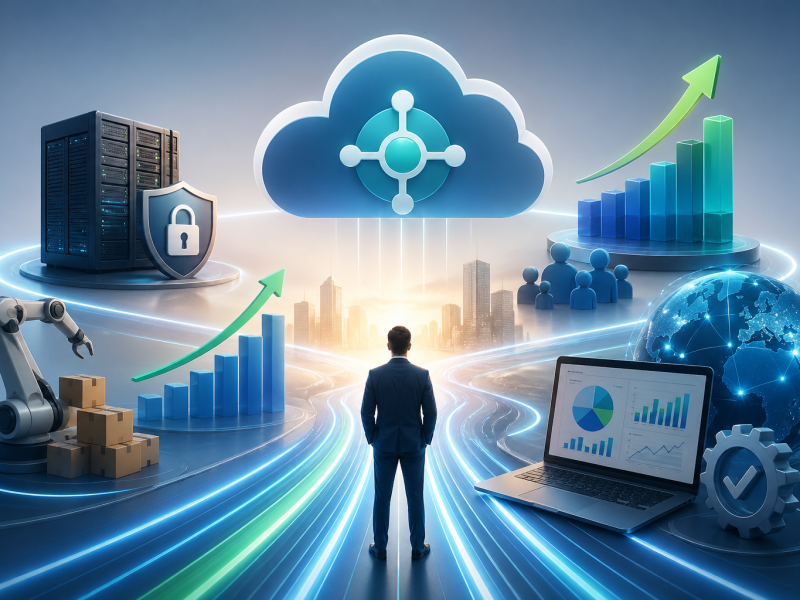
Investing in Microsoft Dynamics 365 Business Central SaaS delivers measurable long-term business value by transforming ERP from a cost center into a growth driver. Organizations benefit from scalability, reduced IT overhead, and continuous innovation, making ERP a strategic asset rather than a sunken cost.
Introduction: ERP as a Strategic Asset
For decades, ERP systems were seen as necessary but burdensome—complex, expensive, and difficult to maintain. Business Central SaaS reframes E as a cloud-native, agile, and ROI-driven platform that empowers organizations to streamline operations, innovate faster, and scale sustainably.
The Long-Term Value Proposition
1. Financial ROI
- Lower Total Cost of Ownership (TCO): SaaS eliminates heavy upfront infrastructure costs.
- Predictable Subscription Pricing: Businesses pay per user, aligning costs with growth.
- Reduced Maintenance Costs: Automatic updates and cloud hosting minimize IT overhead.
2. Scalability and Flexibility
- Elastic Growth: Easily add users or modules as the business expands.
- Industry-Specific Extensions: Tailor ERP to niche needs without disrupting the core system.
- Global Reach: Cloud deployment supports multi-location operations seamlessly.
3. Continuous Innovation
- Regular Updates: Microsoft delivers new features and compliance updates automatically.
- Integration with Microsoft Ecosystem: Power BI, Teams, and Power Platform enhance collaboration and analytics.
- Future-Proofing: SaaS ensures businesses stay aligned with evolving digital standards.
ERP That Pays Off: Tangible Benefits
Operational Efficiency
- Automated Workflows: Reduce manual tasks and errors.
- Unified Data: Real-time visibility across finance, supply chain, and sales.
- Improved Decision-Making: AI-driven insights from integrated analytics.
Employee Productivity
- User-Friendly Interface: Familiar Microsoft environment reduces training time.
- Mobile Access: Employees can work anywhere, boosting flexibility.
- Citizen Development: Low-code tools empower non-technical staff to innovate.
Customer Experience
- Faster Response Times: Integrated CRM and ERP streamline service delivery.
- Personalized Engagement: Data-driven insights improve customer interactions.
- Global Compliance: Built-in localization ensures smooth international operations.
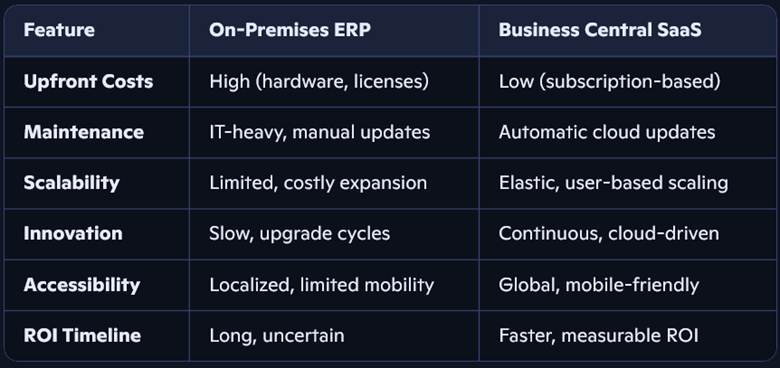
Comparison: On-Premises ERP vs. Business Central SaaS
Risks and Considerations
- Change Management: Transitioning requires training and cultural adaptation.
- Governance: Extensions and low-code apps must be managed to avoid data silos.
- Vendor Dependency: Reliance on Microsoft’s ecosystem requires trust in its roadmap.
Mitigation: Establish governance frameworks, leverage certified AppSource solutions, and align IT with business strategy.
Conclusion: ERP That Pays Off
Business Central SaaS delivers long-term business value by combining financial efficiency, scalability, and continuous innovation. Unlike traditional ERP systems, it evolves with the organization, ensuring that ERP is not just a tool for managing processes but a strategic driver of growth and competitiveness.
For the Microsoft community, the message is clear: ERP pays off when it’s cloud-native, flexible, and designed for the future. Business Central SaaS embodies this vision, making ERP a catalyst for sustainable success. We encourage you to contact us for more information via our SureStep Ambassador team at This email address is being protected from spambots. You need JavaScript enabled to view it..