Blog - Channel Partner
Legacy ERP vs. Business Central SaaS: What You Gain When You Go Cloud-Native
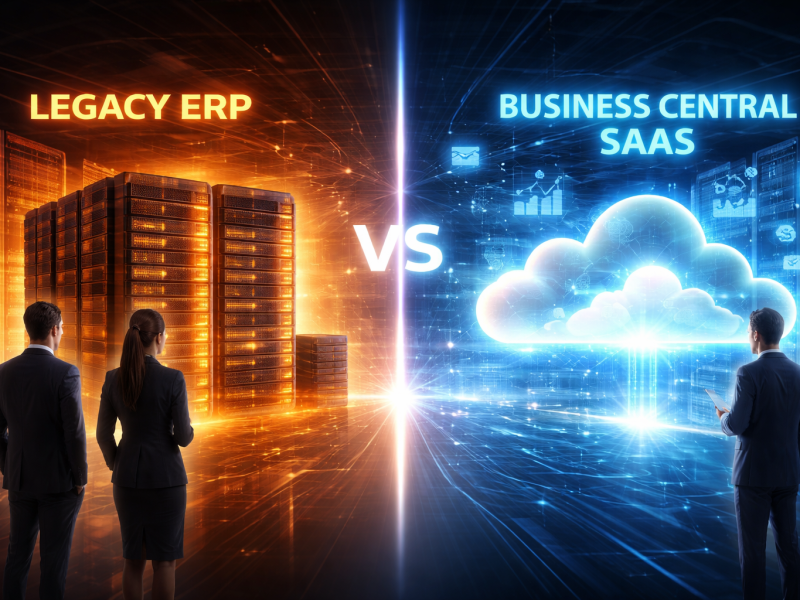
For many businesses, legacy ERP systems have been the backbone of operations for years. They’ve managed finance, supply chains, and customer data reliably enough. But if you’re honest, they often feel more like a burden than a benefit these days. Servers to maintain, upgrades to plan, security patches to worry about—it’s a lot of effort just to keep things running.
Now, compare that with Business Central SaaS, Microsoft’s cloud‑native ERP solution. It’s not just a newer version of ERP—it’s a fundamentally different way of running your business. And the difference between legacy ERP and Business Central SaaS isn’t just technical; it’s strategic.
Here’s what you gain when you make the move.
The Hidden Costs of Legacy ERP
On paper, legacy ERP can look cheaper because the licenses are already paid for. But the reality is different:
- Hardware and infrastructure: Servers, storage, backups, and disaster recovery setups all add up.
- IT overhead: Skilled staff are needed to maintain, patch, and troubleshoot.
- Upgrade projects: Every few years, you face expensive, disruptive upgrades just to stay current.
- Limited scalability: Expanding into new markets or adding users often requires significant investment.
These costs don’t just drain budgets—they slow down innovation.
Business Central SaaS: A Smarter Cost Model
With Business Central SaaS, the economics shift in your favor:
- Predictable subscription pricing: Monthly fees replace large capital expenditures.
- No hardware headaches: Microsoft handles the infrastructure, so you don’t need servers or data centers.
- Automatic updates: New features roll out seamlessly, without disruptive upgrade projects.
- Scalability built‑in: Adding users or expanding globally is as simple as adjusting your subscription.
This frees up your resources to focus on growth instead of maintenance.
Agility vs. Rigidity
Legacy ERP systems are rigid. Customizations are complex, integrations are clunky, and adapting to new business models can take months.
Business Central SaaS is built for agility:
- Rapid adaptability: Updates and new features arrive automatically, keeping you ahead of change.
- Easy integrations: Native connections to Microsoft 365, Teams, and Power BI make collaboration and reporting seamless.
- Low‑code innovation: Tools like Power Apps and Power Automate let you build workflows and apps without heavy IT involvement.
This agility is critical in today’s environment, where customer expectations and market conditions shift constantly.
Security and Compliance: Who Carries the Risk?
With legacy ERP, the responsibility for security and compliance falls squarely on your business. That means patching servers, managing firewalls, and ensuring compliance with regulations like GDPR.
Business Central SaaS changes the equation:
- Enterprise‑grade security: Built on Microsoft Azure, with encryption, identity management, and threat detection.
- Global compliance: Microsoft adheres to international standards, reducing the burden on you.
- Resilience: Cloud infrastructure ensures business continuity even in times of disruption.
That peace of mind is worth a lot.
Innovation Pace: Yesterday vs. Tomorrow
Legacy ERP systems are stuck in the past. Innovation is slow, and businesses often wait years for new features.
Business Central SaaS is future‑focused:
- AI and automation: Cloud‑native capabilities bring predictive analytics, intelligent insights, and automation.
- Continuous improvement: Microsoft invests heavily in SaaS, ensuring you benefit from the latest advancements.
- Global reach: Cloud infrastructure makes international expansion easier, without worrying about local servers.
Staying on legacy ERP means missing out. Moving to SaaS means being ready for what’s next.
Migration: Easier Than You Think
One of the biggest fears about leaving legacy ERP is the migration process. But Microsoft has made it easier:
- Migration tools: Automated utilities reduce manual effort.
- Partner support: You’ll have guidance from experienced partners and distributors.
- Phased approach: You can migrate step by step, starting with specific modules or subsidiaries.
Yes, migration requires planning. But it’s far less daunting than many expect—and the payoff is worth it.
What You Gain as a Customer
The benefits of moving to Business Central SaaS are clear:
- Reduced IT burden: No more servers, patches, or backups to manage.
- Always current: Access to the latest features without disruptive upgrades.
- Business resilience: Cloud‑based operations ensure continuity even in times of disruption.
- Innovation at speed: Faster adoption of new capabilities keeps you competitive.
The Cloud‑Native Advantage
The difference between legacy ERP and Business Central SaaS isn’t just about technology—it’s about strategy. Legacy ERP ties you to the past, with hidden costs, rigid systems, and slow innovation. Business Central SaaS opens the door to agility, security, scalability, and future‑proof growth.
The gains are clear. The question is whether you want to keep investing in yesterday—or start building for tomorrow.
If you’re still running on legacy ERP, now is the time to explore Business Central SaaS. We encourage you to reach out to our SureStep Ambassador team at This email address is being protected from spambots. You need JavaScript enabled to view it. and we’ll guide you through the process and make sure your move to Business Central SaaS is a win from day one.